Your tiles are organized, the Charleston is complete, and you have some ideas about possible hands. Now the regular game begins. The basic rhythm is surprisingly simple: pick a tile, look at your hand, and discard a tile. Don’t worry about remembering everything the first time. Once you understand the basic rhythm, the rest becomes much easier.
Lesson 1
Pick and Discard
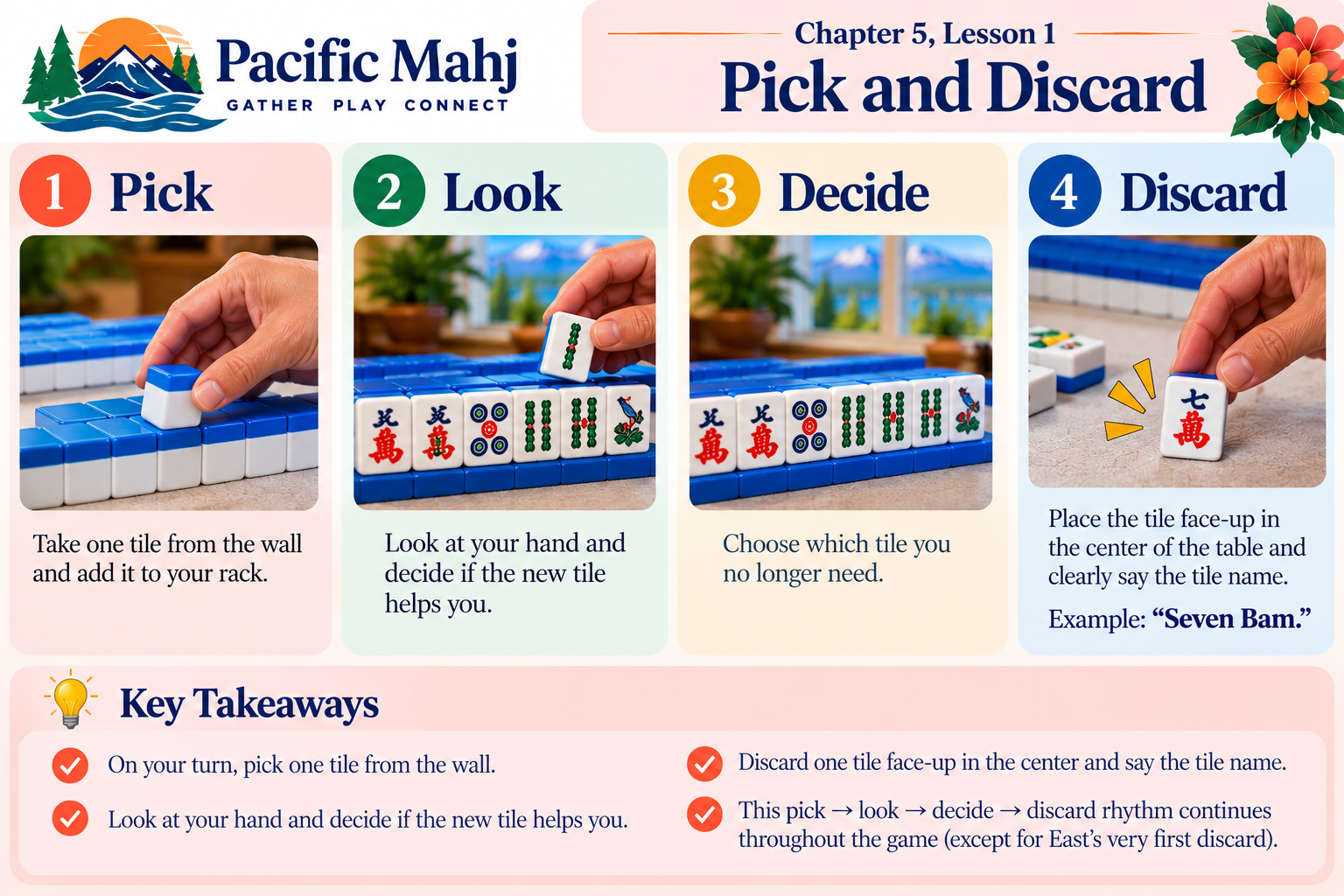
After the Charleston is finished, East begins regular play by discarding one tile from their 14-tile hand. From there, play continues around the table. On a normal turn, you pick one tile from the wall, look at your hand and decide whether the new tile helps you, then discard one tile face-up into the center. That’s the basic rhythm: Pick → Look → Decide → Discard. Especially while you’re learning, take a moment to look at your rack and card before choosing what to discard.
Pick → Look → Decide → Discard — the basic rhythm of a turn.
Lesson 2
Understanding 13 and 14 Tiles
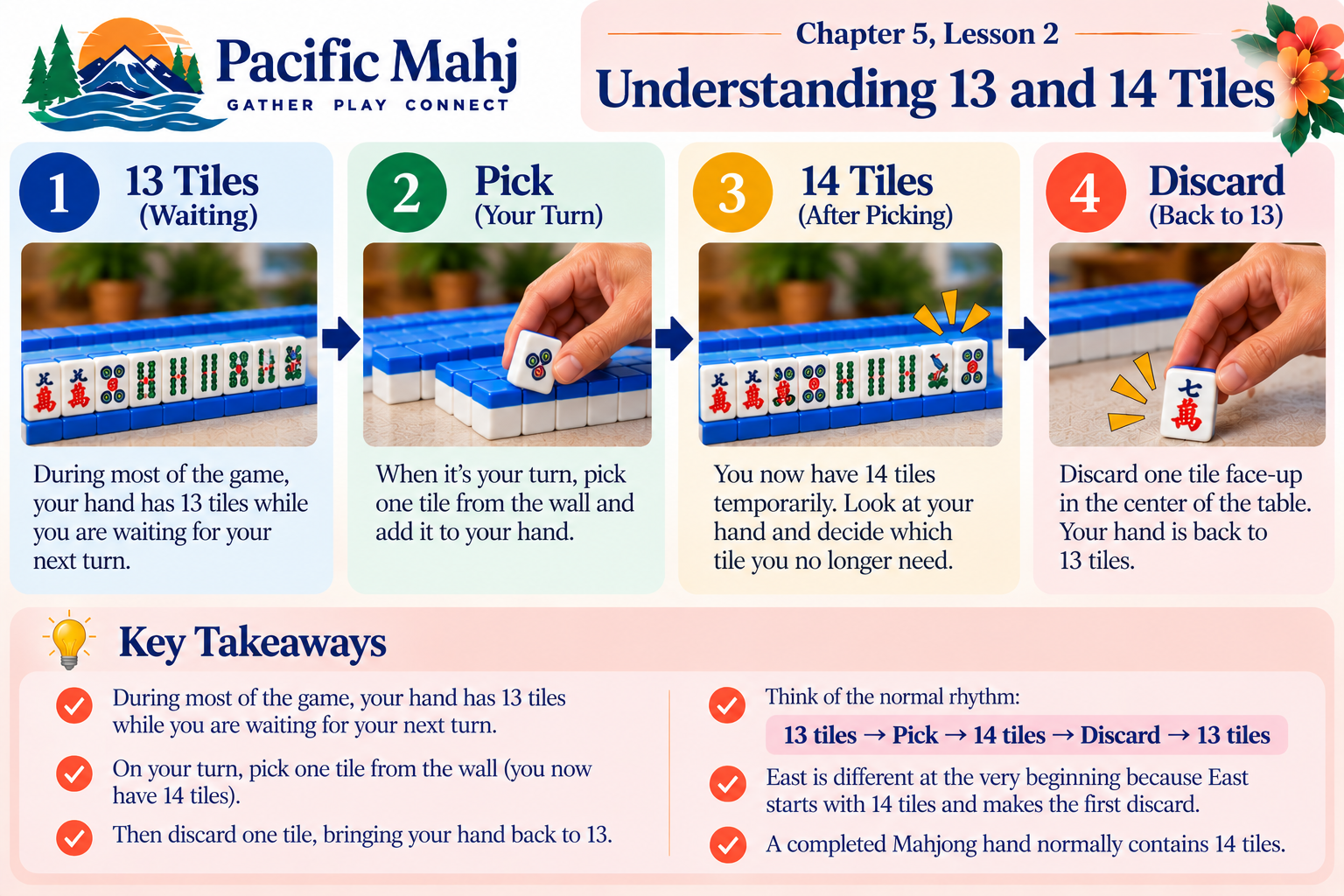
During most of the game, your concealed hand will have 13 tiles while you’re waiting for your next turn. When your turn arrives, you pick a tile from the wall and temporarily have 14 tiles. You then discard one tile, bringing your hand back to 13. Think: 13 tiles → Pick → 14 tiles → Discard → 13 tiles. East is different at the very beginning because East starts with 14 tiles and makes the first discard. A completed Mahjong hand normally contains 14 tiles.
13 tiles → Pick → 14 tiles → Discard → 13 tiles.
Lesson 3
Discarding a Tile
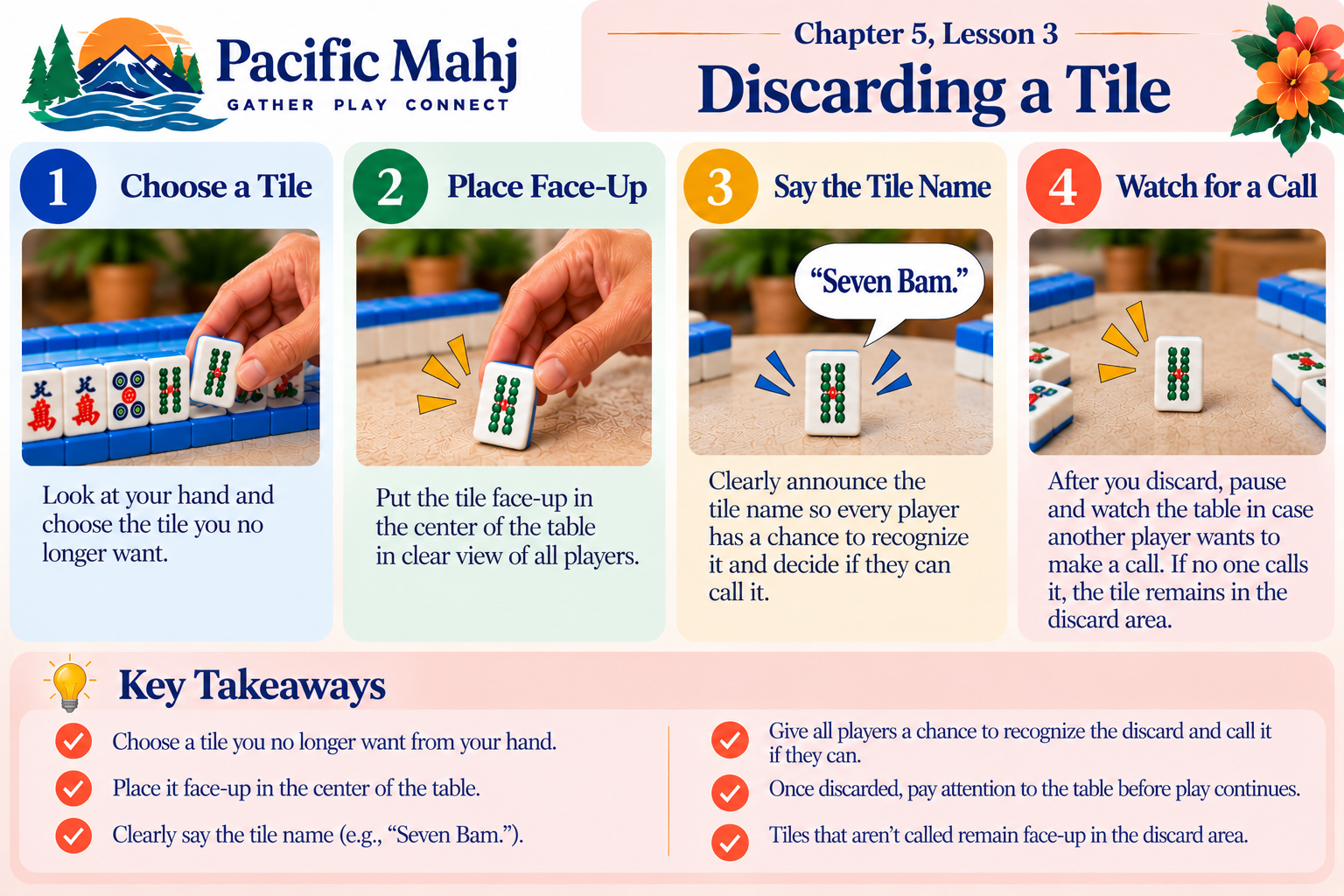
When you decide which tile you no longer want, place it face-up in the center of the table and clearly announce its name—for example, “Seven Bam.” Saying the tile aloud gives every player an opportunity to recognize the discard and decide whether they can legally call it. Once you’ve clearly discarded the tile, pay attention to the table before play continues because another player may want it.
Choose the tile, place it face-up, announce it clearly, and watch for a call.
Lesson 4
What Happens to Discards?
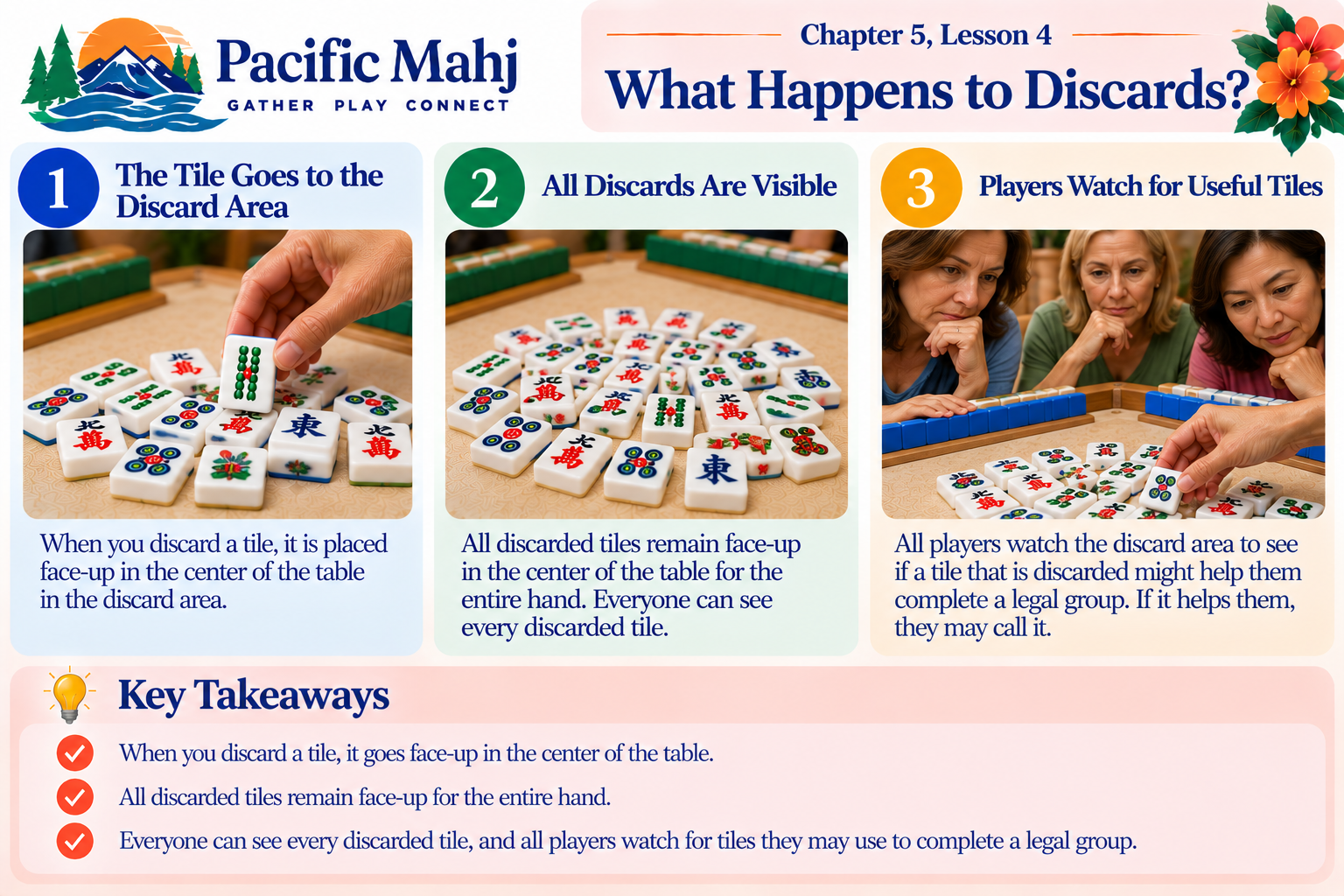
Tiles that aren’t called remain face-up in the center of the table. Don’t think of those discarded tiles as clutter—they’re information. As the game progresses, the discard area can help you see which tiles have already appeared and which may still be available. At first, you don’t need to study every discard. Simply begin developing the habit of noticing what’s on the table.
Discards stay visible, giving every player useful information throughout the hand.
Lesson 5
Calling a Tile
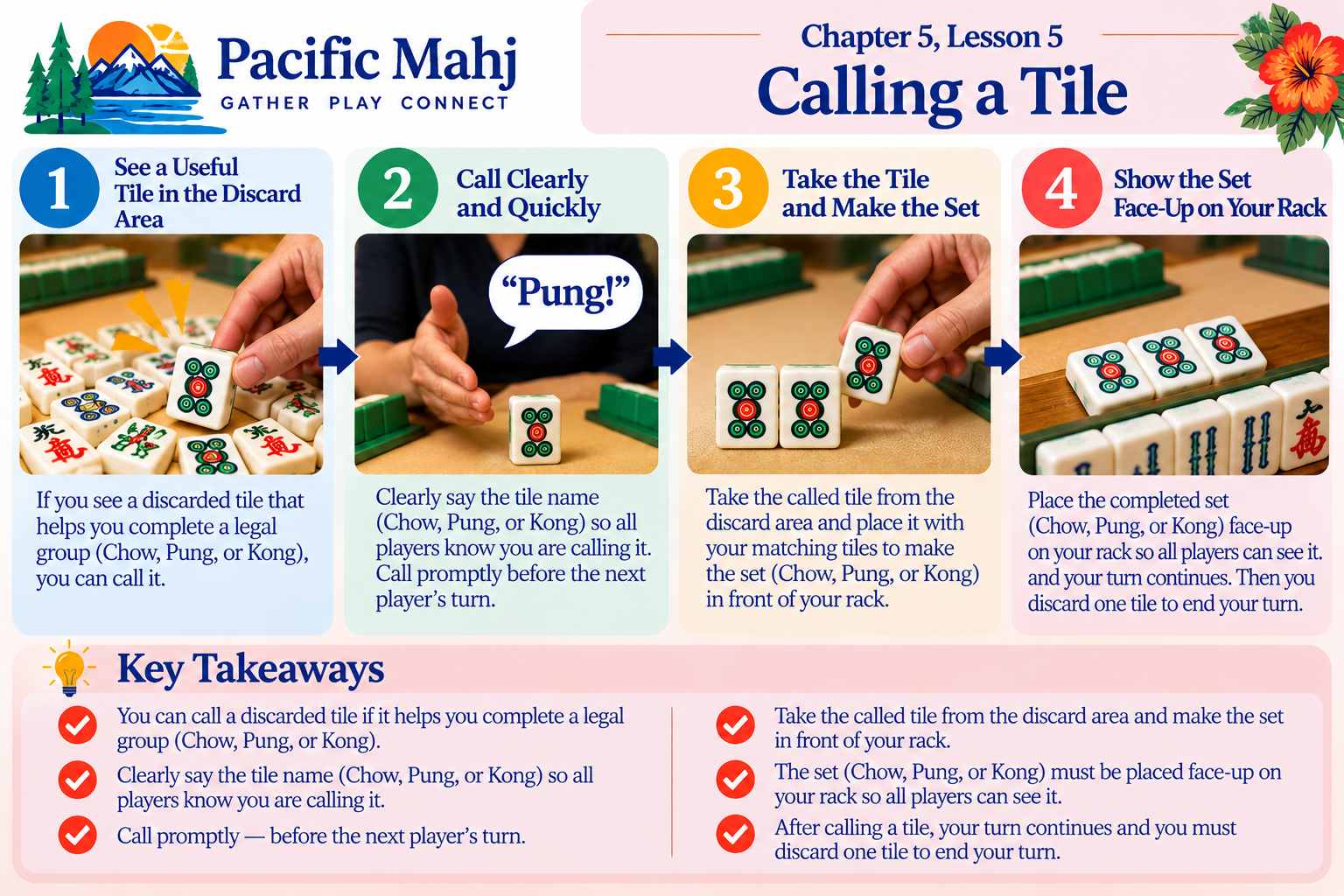
Sometimes another player’s discard is exactly what you need. Under the rules of American Mahjong, certain discarded tiles may be called when they legally complete a group required by the hand you’re playing. A discard may also be called when it completes your Mahjong. You cannot simply take a discarded tile because it might be useful later—the tile must satisfy the rules for making the call. We’ll cover special situations and restrictions in Chapter 6.
Recognize a legal call, call promptly, make the set, and display the exposure face-up.
Lesson 6
Making an Exposure
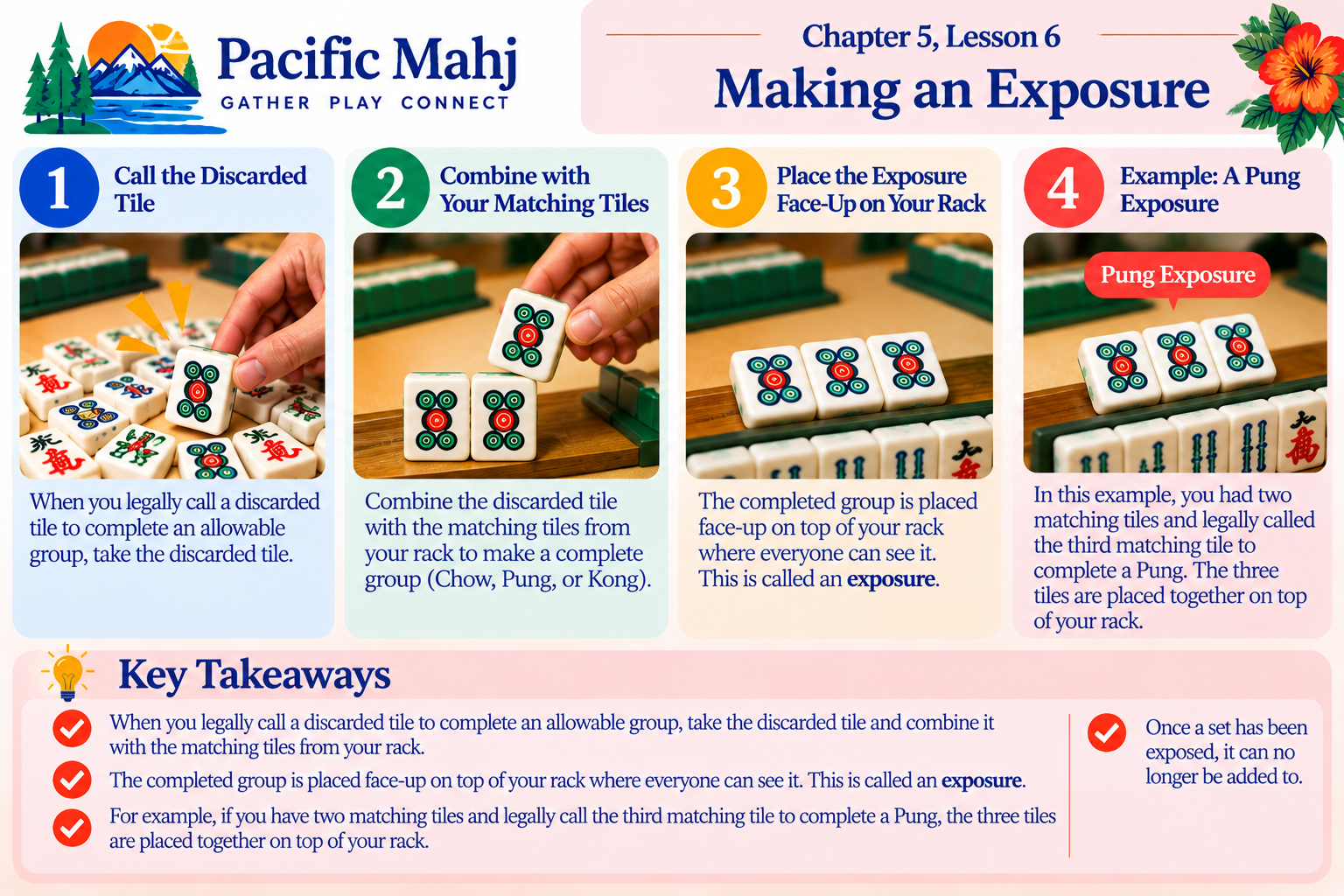
When you legally call a discarded tile to complete an allowable group, take the discarded tile and combine it with the matching tiles from your rack. That completed group is placed face-up on top of your rack where everyone can see it. This is called an exposure. For example, if you have two matching tiles and legally call the third matching tile to complete a Pung, the three tiles are placed together on top of your rack. Once a set has been exposed, it can no longer be added to.
Call the tile, combine the matching tiles, and place the completed exposure face-up on top of your rack.
Lesson 7
Who Plays Next After a Call?
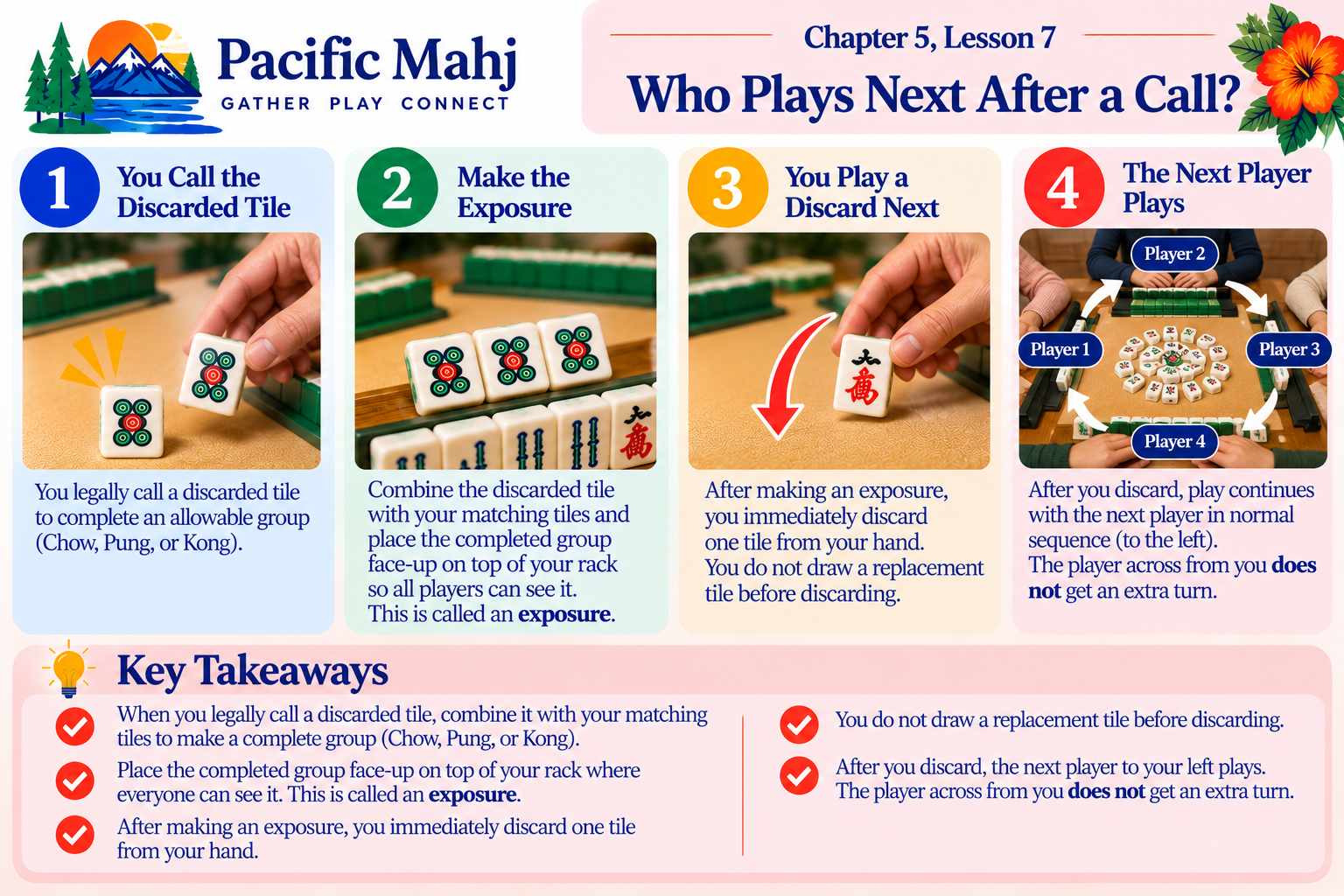
Normally, play moves around the table in order, but a legal call can interrupt that order. When a player legally calls a discarded tile and makes an exposure, that player takes the turn. After completing the exposure, the player discards a tile and play continues from that player’s position. One or more players may occasionally have their normal turn skipped because another player called a discard.
A legal call interrupts the normal order; after the caller exposes and discards, play continues from that position.
Lesson 8
Using Jokers
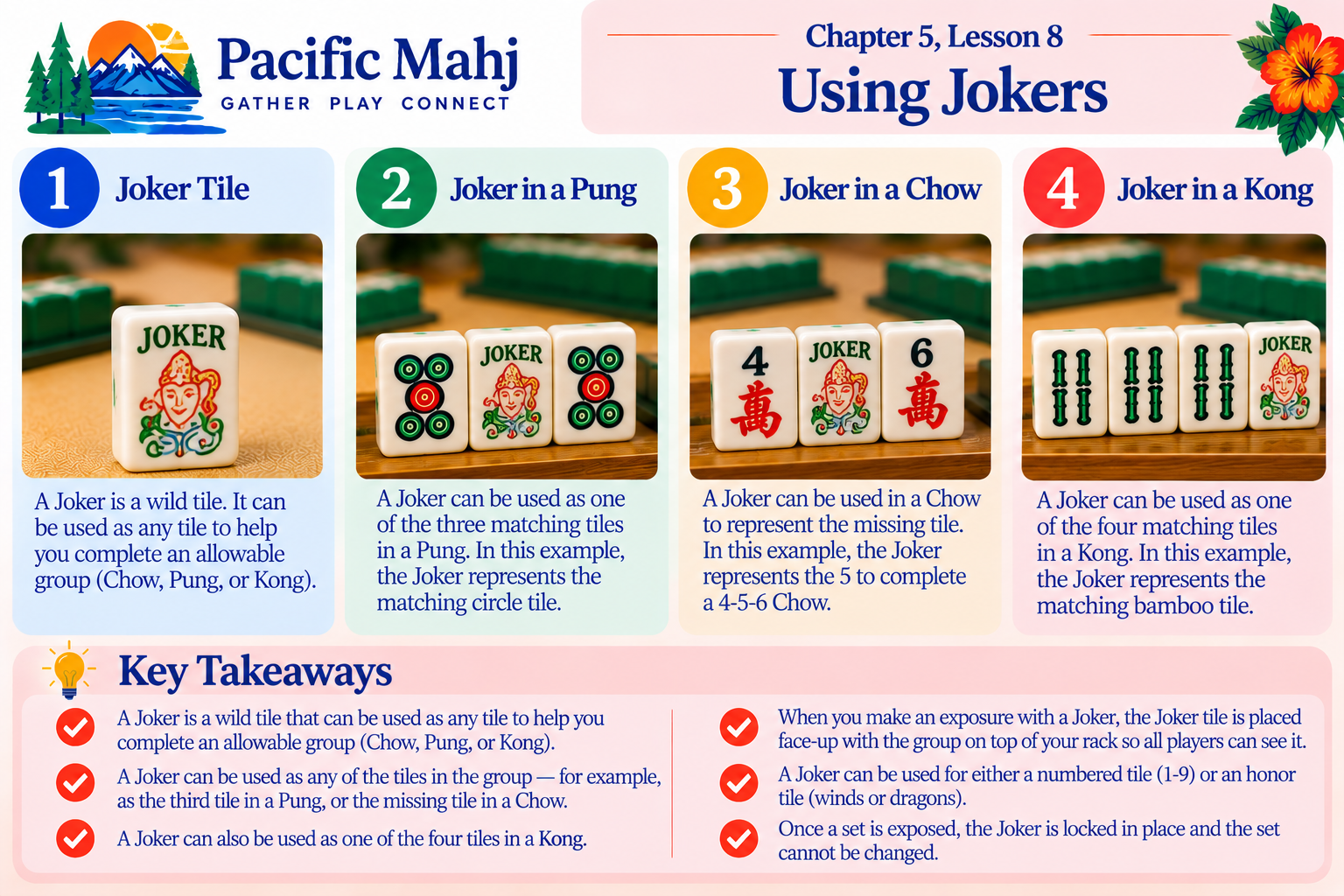
Jokers are powerful because they can substitute for tiles in certain groups—but they cannot be used everywhere. In American Mahjong, Jokers may generally be used in groups of three or more identical tiles, such as Pungs, Kongs and Quints. Jokers cannot be used in Singles or Pairs. A useful beginner reminder is: Singles and Pairs = No Jokers. Pungs, Kongs and Quints = Jokers may be allowed. The card and the requirements of the hand still matter.
Jokers can substitute only where the rules allow; always follow the requirements of the hand.
Lesson 9
Joker Exchanges
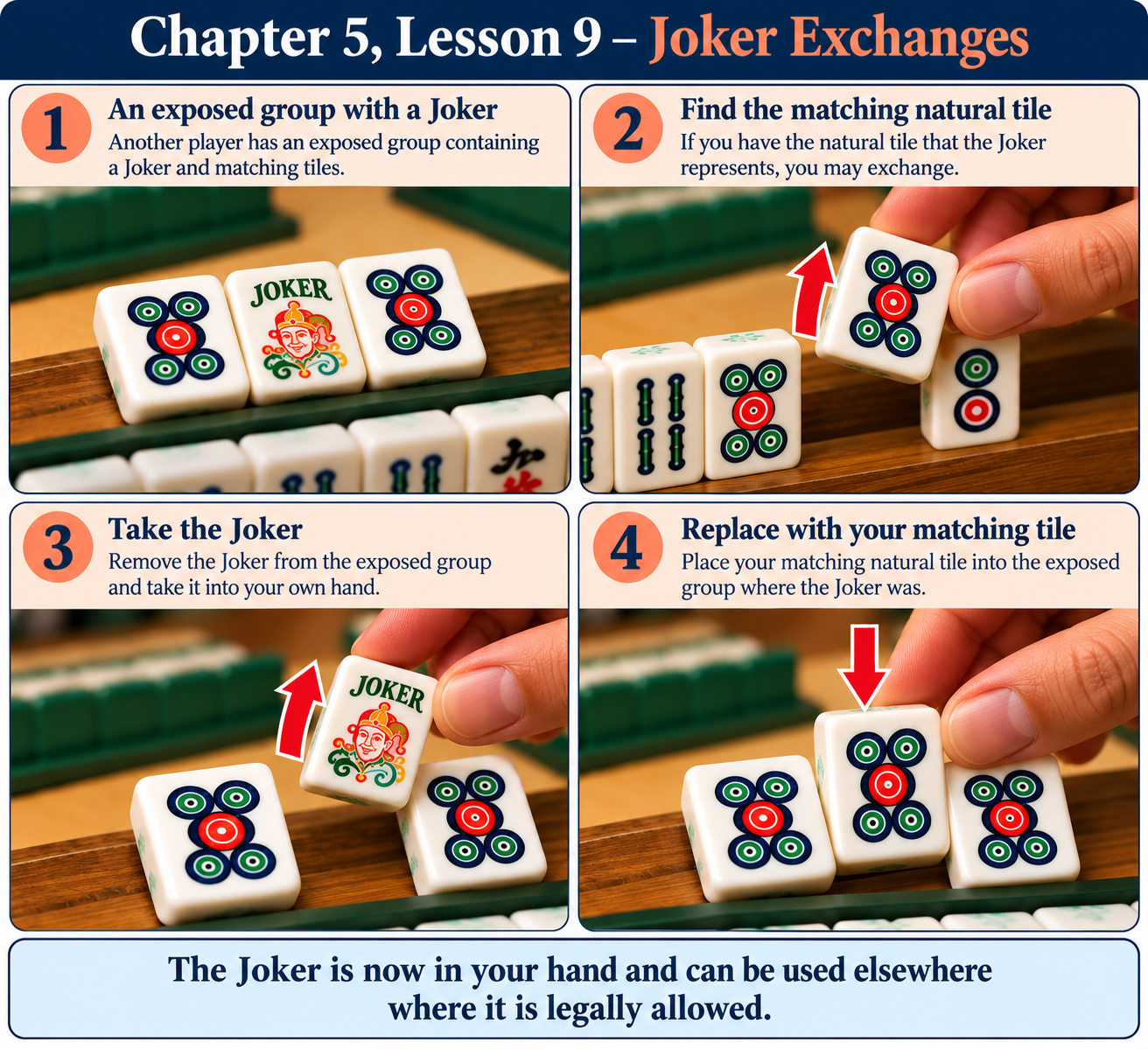
Sometimes another player has an exposed group containing a Joker and you have the natural tile that the Joker represents. When permitted, you may exchange your matching natural tile for that exposed Joker. You place the natural tile into the exposure and take the Joker into your own hand. The Joker can then be used elsewhere where it is legally allowed. We’ll cover the timing rules more carefully in Chapter 6.
Replace an exposed Joker with its matching natural tile and take the Joker into your own hand.
Lesson 10
Calling Mahjong
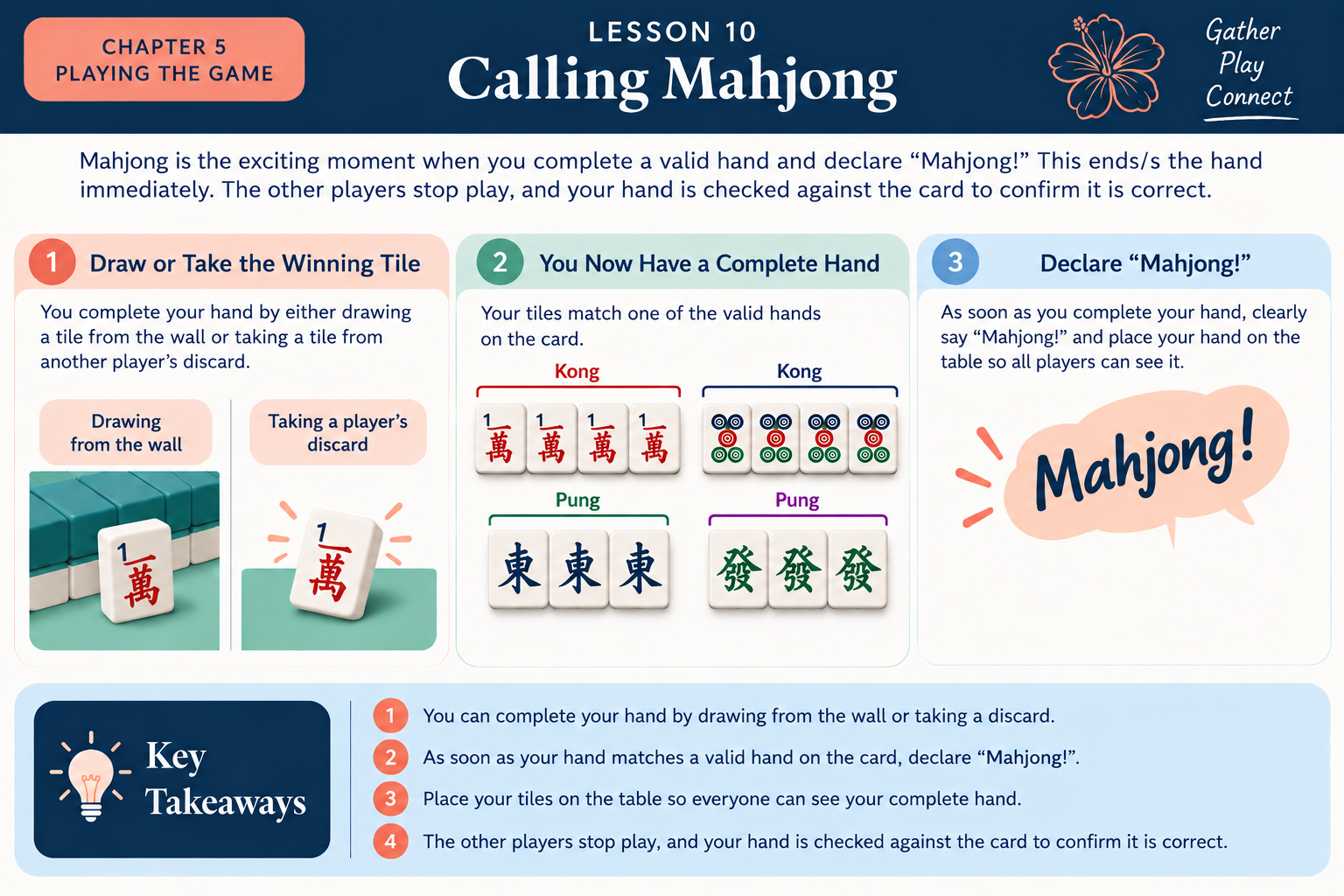
When your 14 tiles exactly complete one of the hands on the Mahjong card, you’ve made Mahjong. Announce “Mahjong!” Your completed hand is then shown so the other players can verify that it matches the line and requirements on the card. Mahjong may sometimes be completed with a tile you pick yourself and sometimes with an eligible discard, depending on the hand and situation.
Complete the hand, declare “Mahjong!”, and show the hand so it can be verified against the card.
Lesson 11
Wall Games
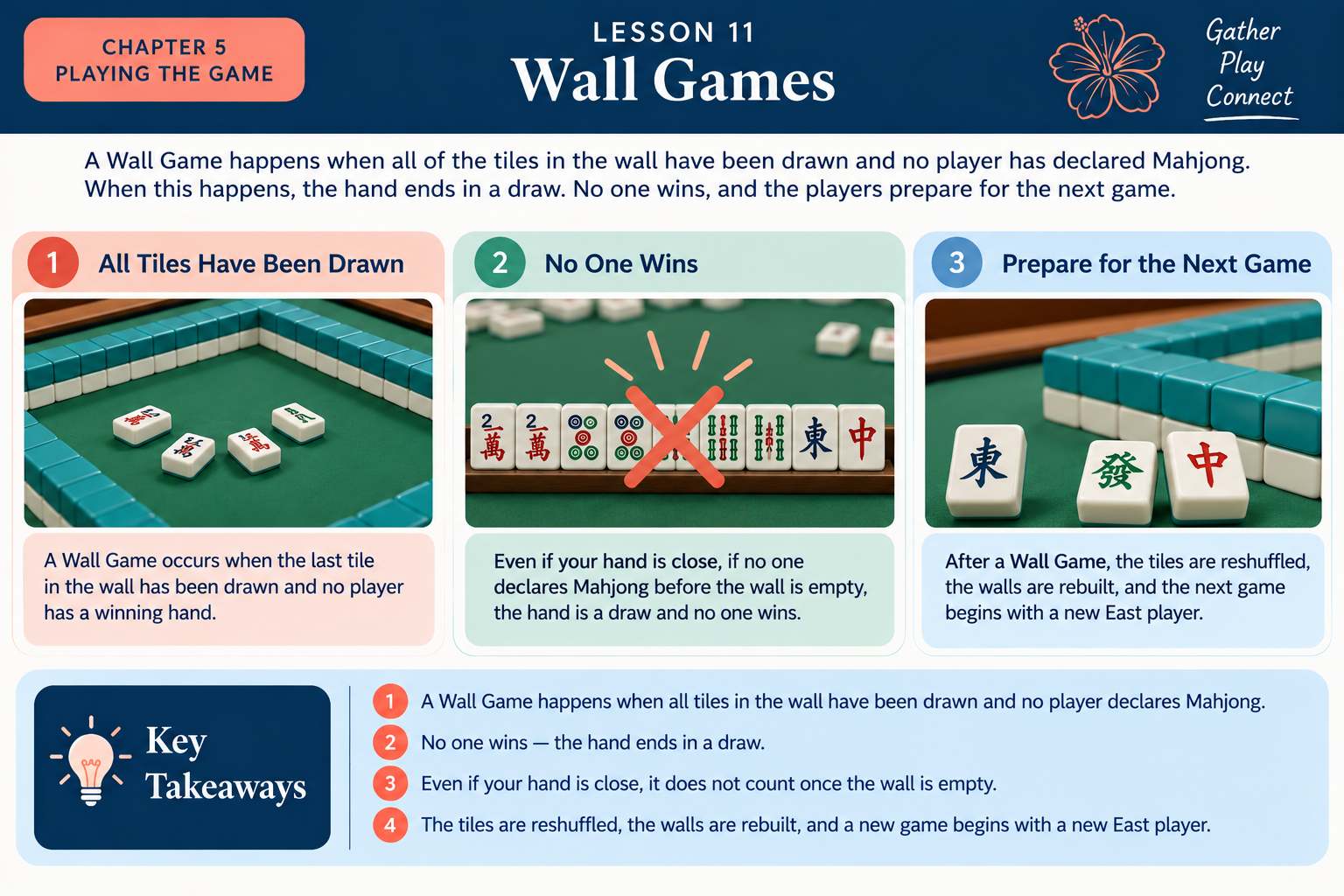
Not every game ends with someone calling Mahjong. Sometimes the playable tiles are exhausted before anyone completes a hand. When that happens, the game ends as a wall game. That’s completely normal. Nobody failed, and there doesn’t have to be a winner every hand. Shuffle the tiles, build the walls again, and start another game. Some of the most interesting games are the ones where everyone gets close—but nobody quite gets there.
If the playable wall is exhausted before anyone declares Mahjong, the hand ends as a wall game and everyone starts fresh.
Chapter Complete
You Just Played Mahjong
That’s the basic rhythm of the game: pick, evaluate, discard—and watch what happens around the table. You don’t need to remember every special situation yet. The more you play, the more natural the rhythm becomes. When something unusual happens, just ask. That’s how everyone learned. You’ve now gone from opening a box of unfamiliar tiles to understanding how an actual game moves around the table. Next, we’ll look at some of the rules and situations that new players naturally have questions about.