Lesson 1
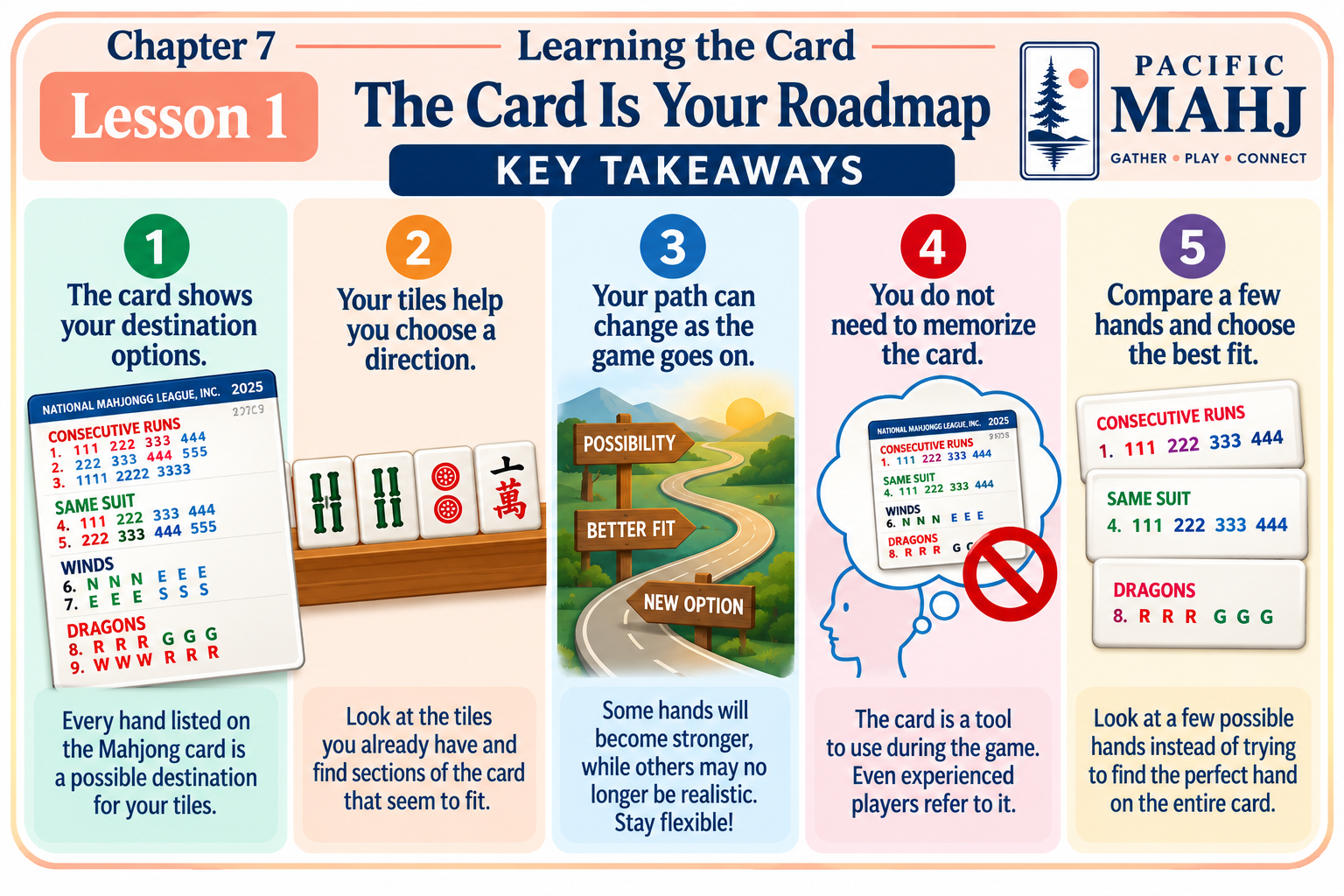
The Card Is Your Roadmap
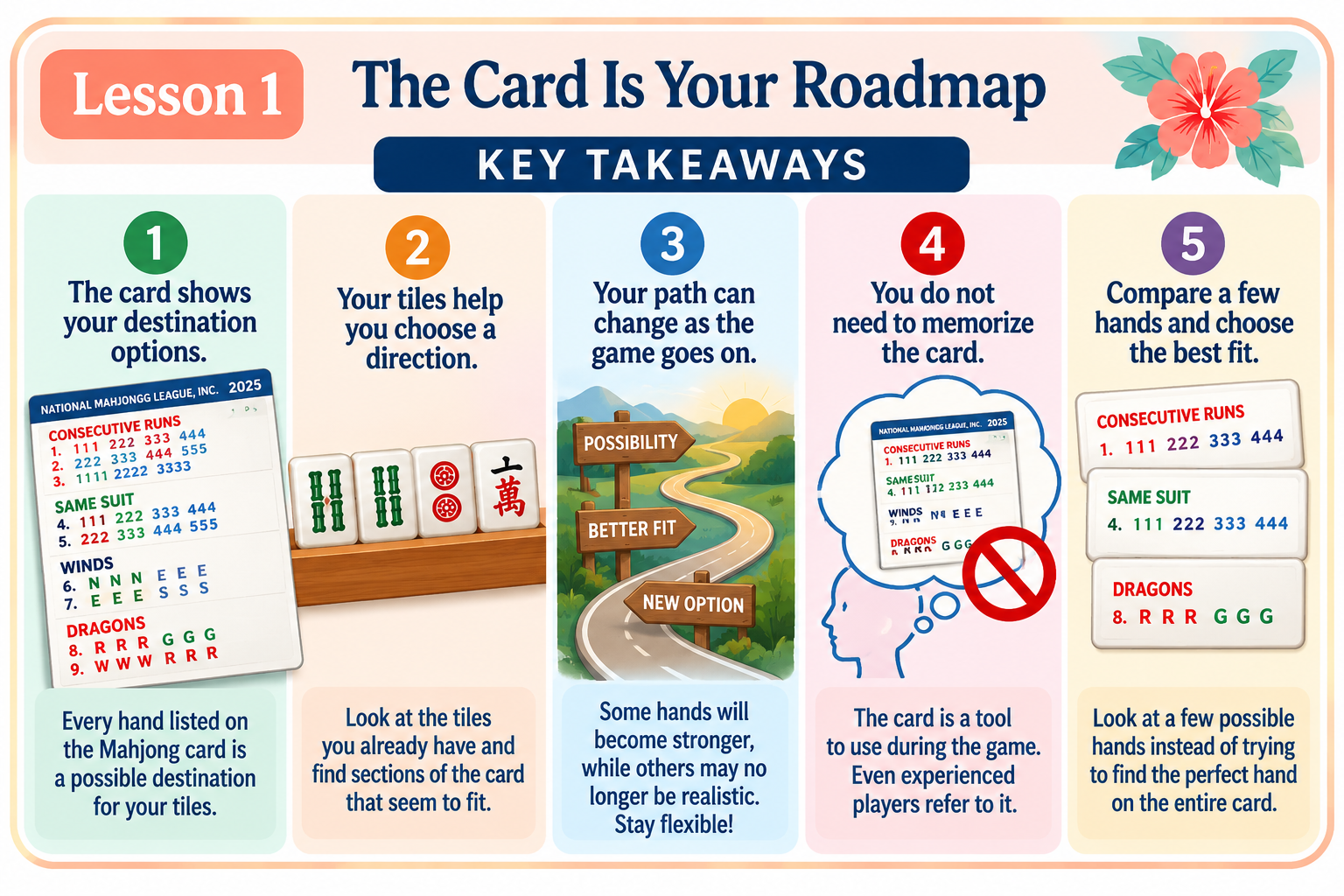
The Mahjong card is the roadmap for your hand. Each line shows one possible winning combination, including the tiles, group sizes and any special requirements you must follow. You may look at the card throughout the game, so use it often. The goal is not to memorize every line—it is to learn how to read the information the card gives you.
Lesson 2
Understanding the Sections
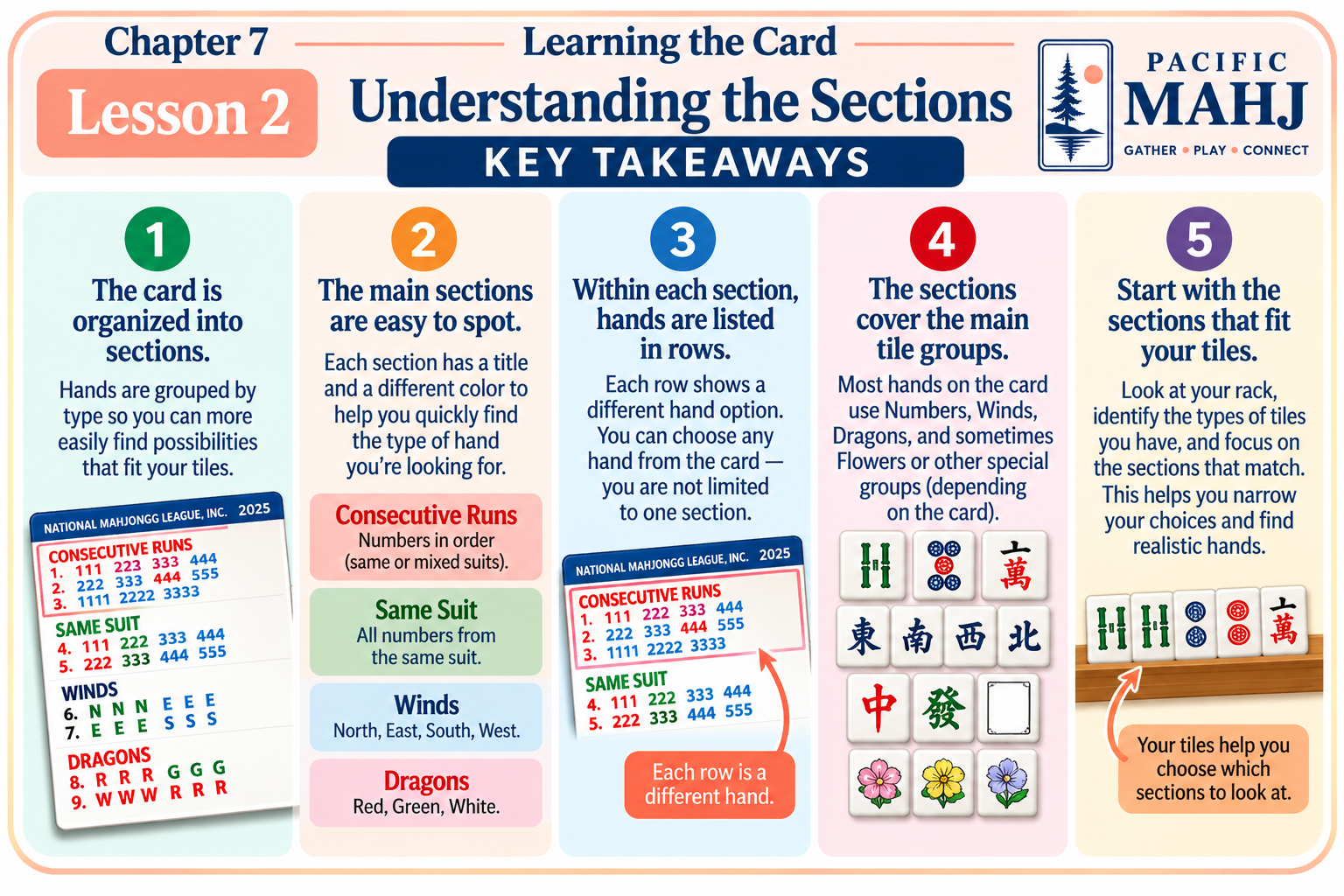
The card is divided into sections that group hands with similar ideas or patterns. Section headings help you narrow your search instead of scanning every line at once. As your tiles develop, look for sections that match what you already have. Learning the sections makes the card feel smaller, more organized and much easier to use.
Lesson 3
Reading a Line from Left to Right
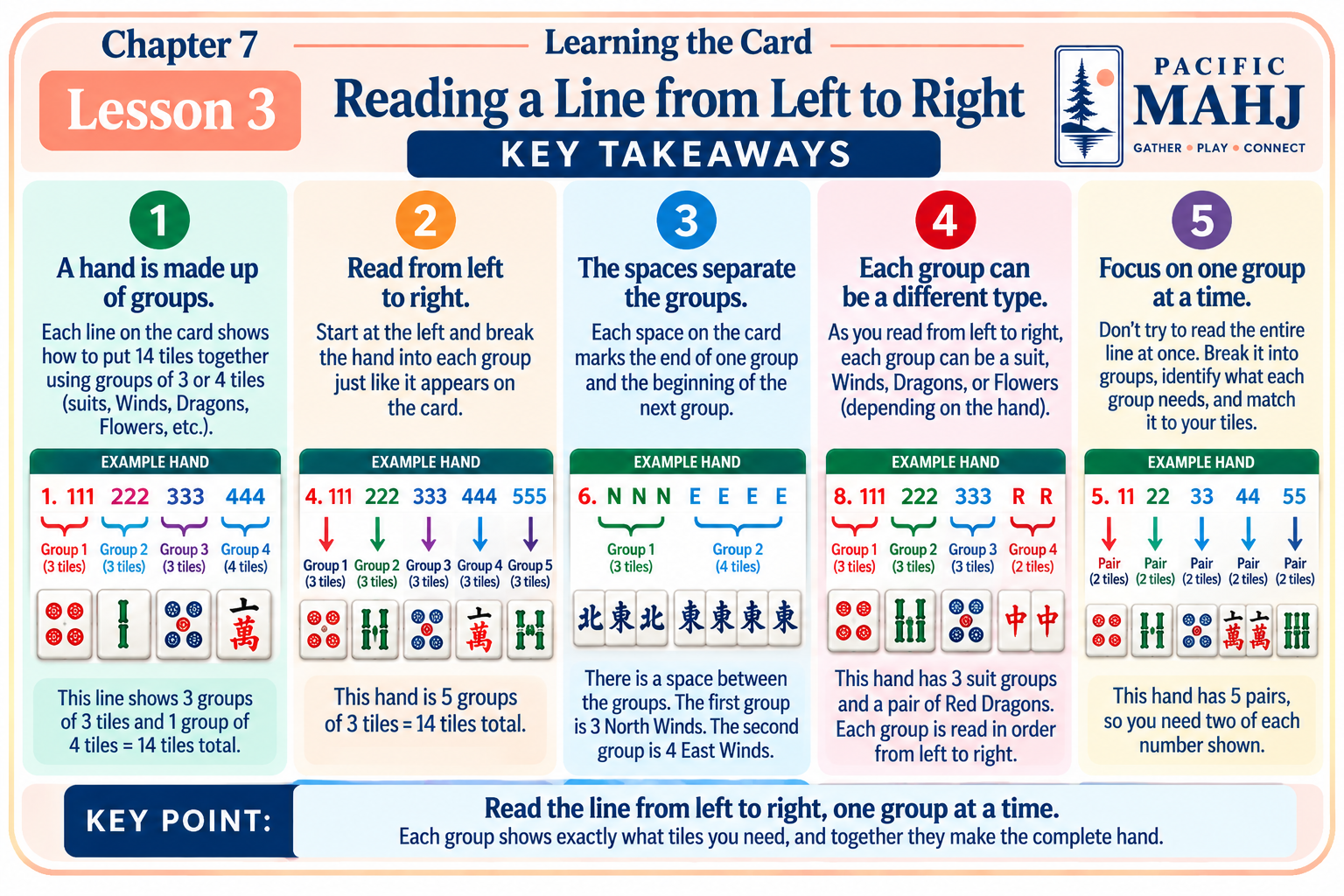
Read each line from left to right as one complete set of instructions for a winning hand. Notice where groups begin and end, how many tiles belong in each group, and whether the line uses numbers, Winds, Dragons or Flowers. Do not read only the first few tiles—every group on the line must be completed exactly as required.
Lesson 4
Numbers, Letters & Symbols
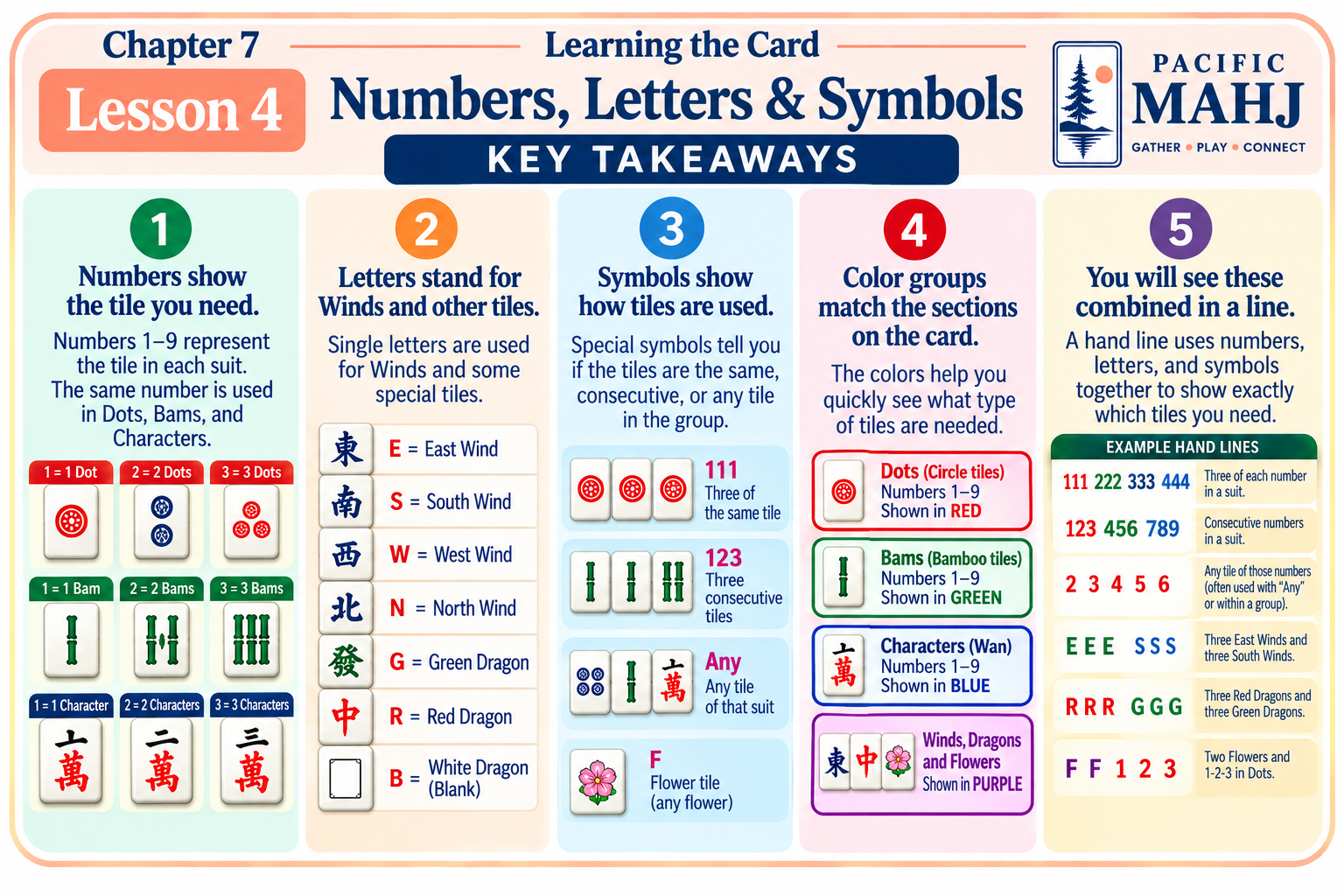
Numbers on the card generally represent numbered suited tiles. Letters and symbols stand for special tiles or instructions—for example N, E, W and S for Winds, F for Flowers and D for Dragons. Read the entire line and its notes together. With practice, these shortcuts become familiar and let you understand a hand at a glance.
Lesson 5
What the Colors Mean
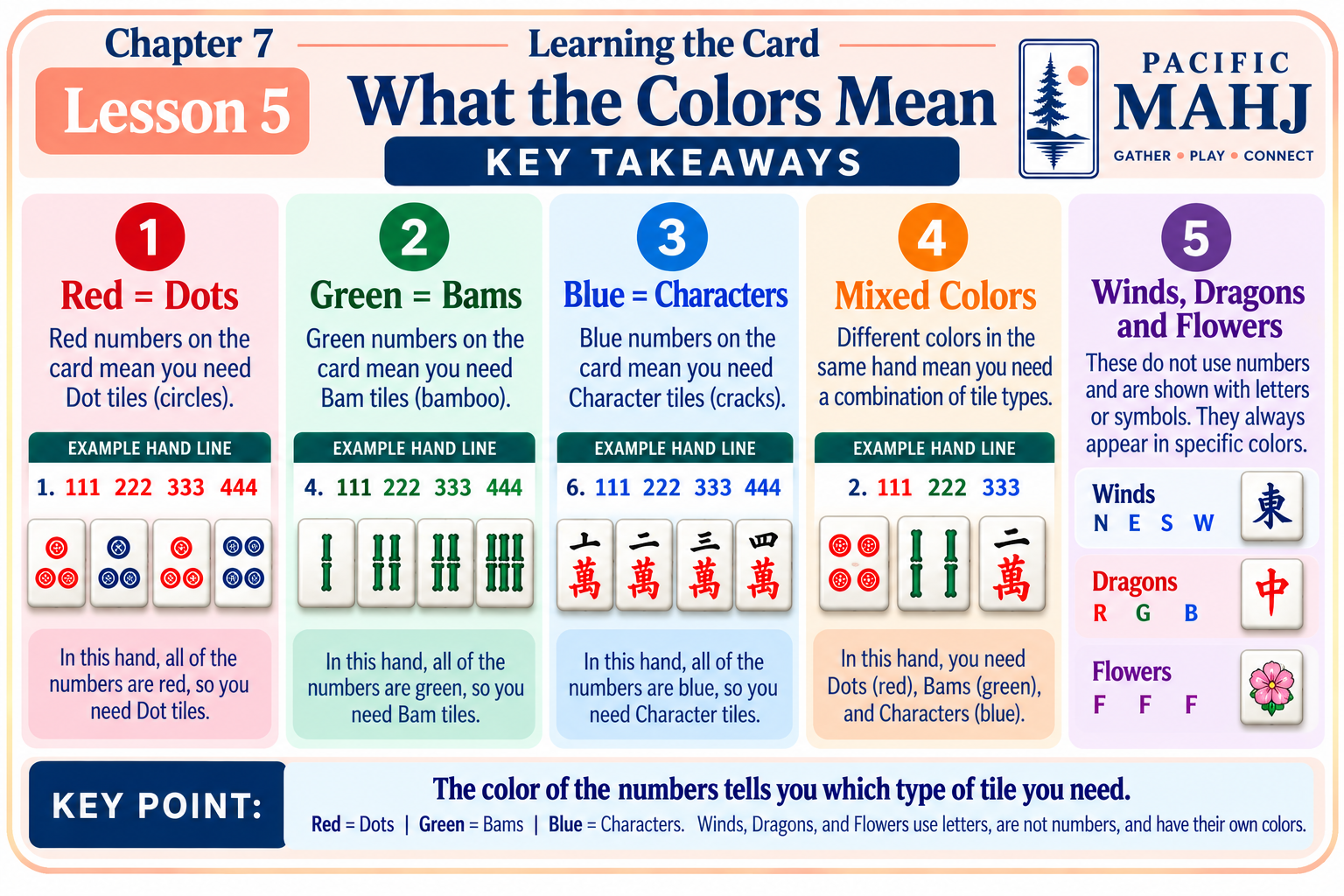
Colors on the card show relationships between suits; they do not permanently represent Dots, Bams or Craks. Tiles shown in the same color must use the same suit, while a different color indicates a different suit. You choose which actual suit fills each color role unless the line says otherwise. Think relationship first, suit second.
Lesson 6
Understanding “Any”
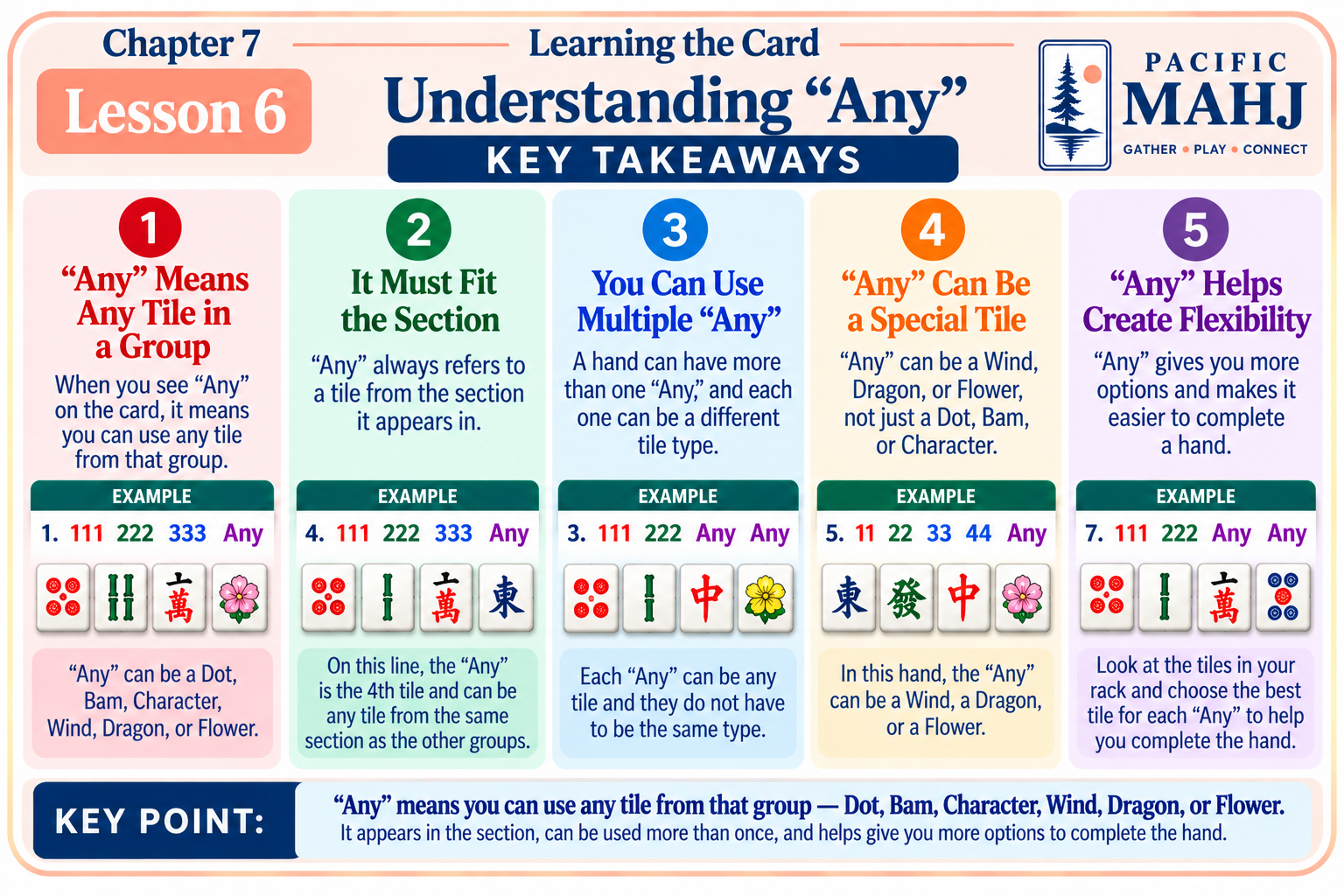
The word “Any” gives you flexibility, but only within the limits stated on the line. “Any Suit,” “Any Dragon,” or “Any Consecutive Numbers” means you may choose an option that satisfies that instruction. Once you choose how the line works for your hand, the rest of the tiles still must follow the relationships and requirements shown.
Lesson 7
Parentheses & Special Instructions
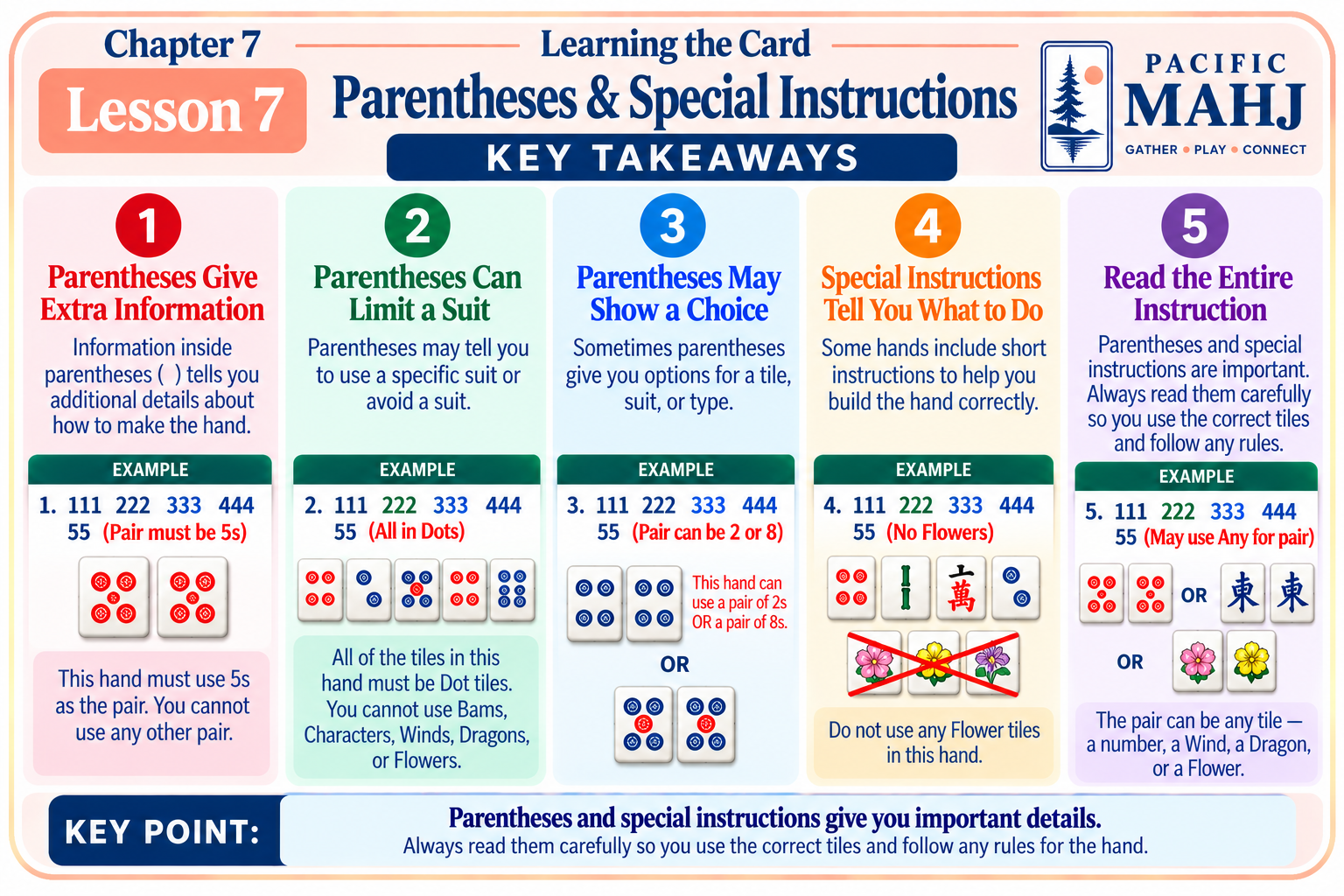
The words in parentheses are part of the hand, not optional notes. They may tell you which numbers can be used, how suits relate, which Dragon belongs with a suit, or another condition needed for the line to be valid. Always read the pattern and the parenthetical instructions together before committing to a hand.
Lesson 8
Exposed vs. Concealed Hands
The card tells you whether a hand may be played exposed or must remain concealed. An exposed hand can generally use legal calls to place qualifying groups face-up on the rack. A concealed hand normally stays hidden while you build it, with calling restricted by the rules. Check this designation before making an exposure.
Lesson 9
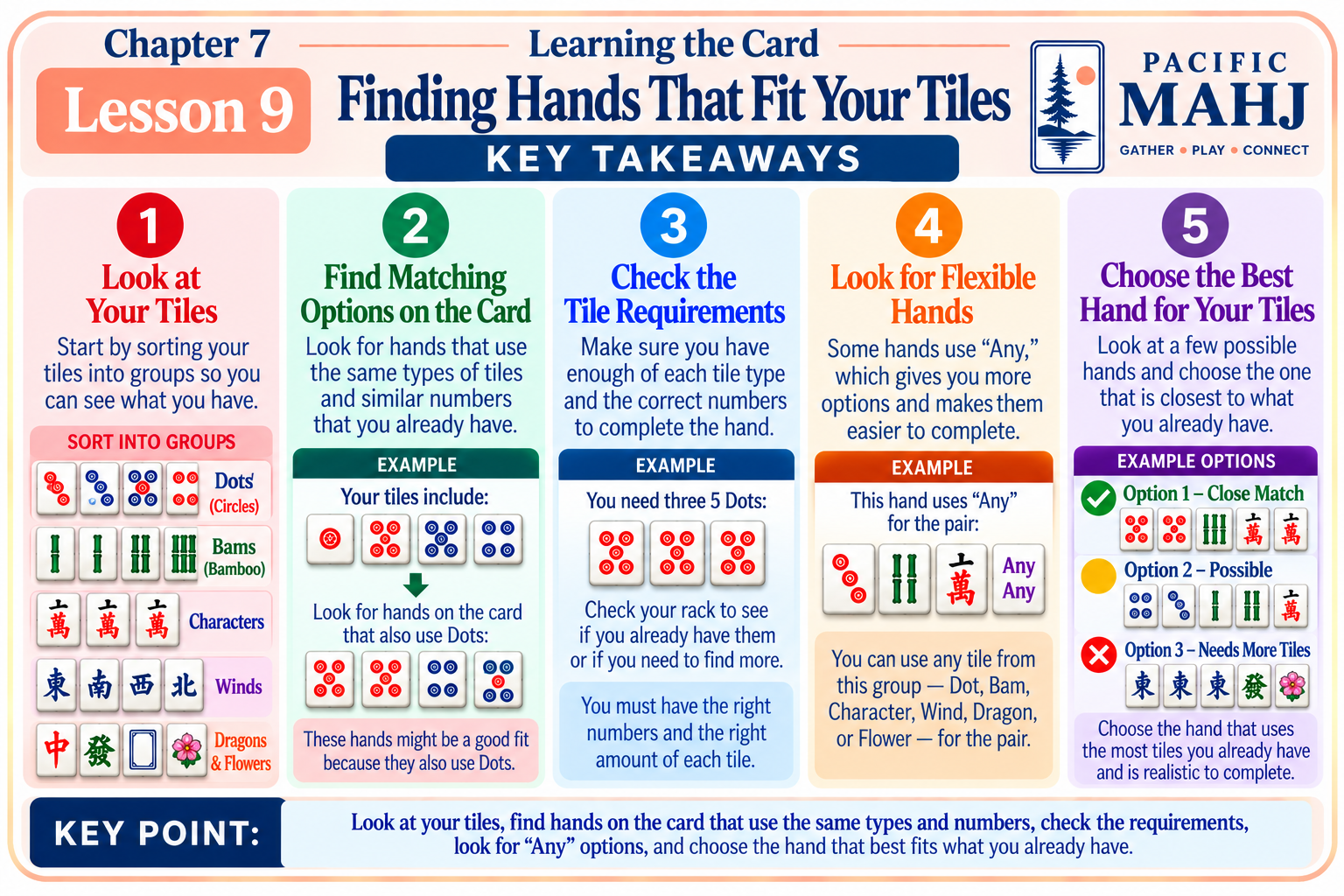
Finding Hands That Fit Your Tiles
Start with the tiles you actually have, then look for card lines that already match several of them. Pay attention to strong groups, useful pairs, Flowers, Winds and Dragons, and flexible number patterns. You do not need a perfect match immediately. Choose possibilities that let your current tiles do as much work as possible.
Lesson 10
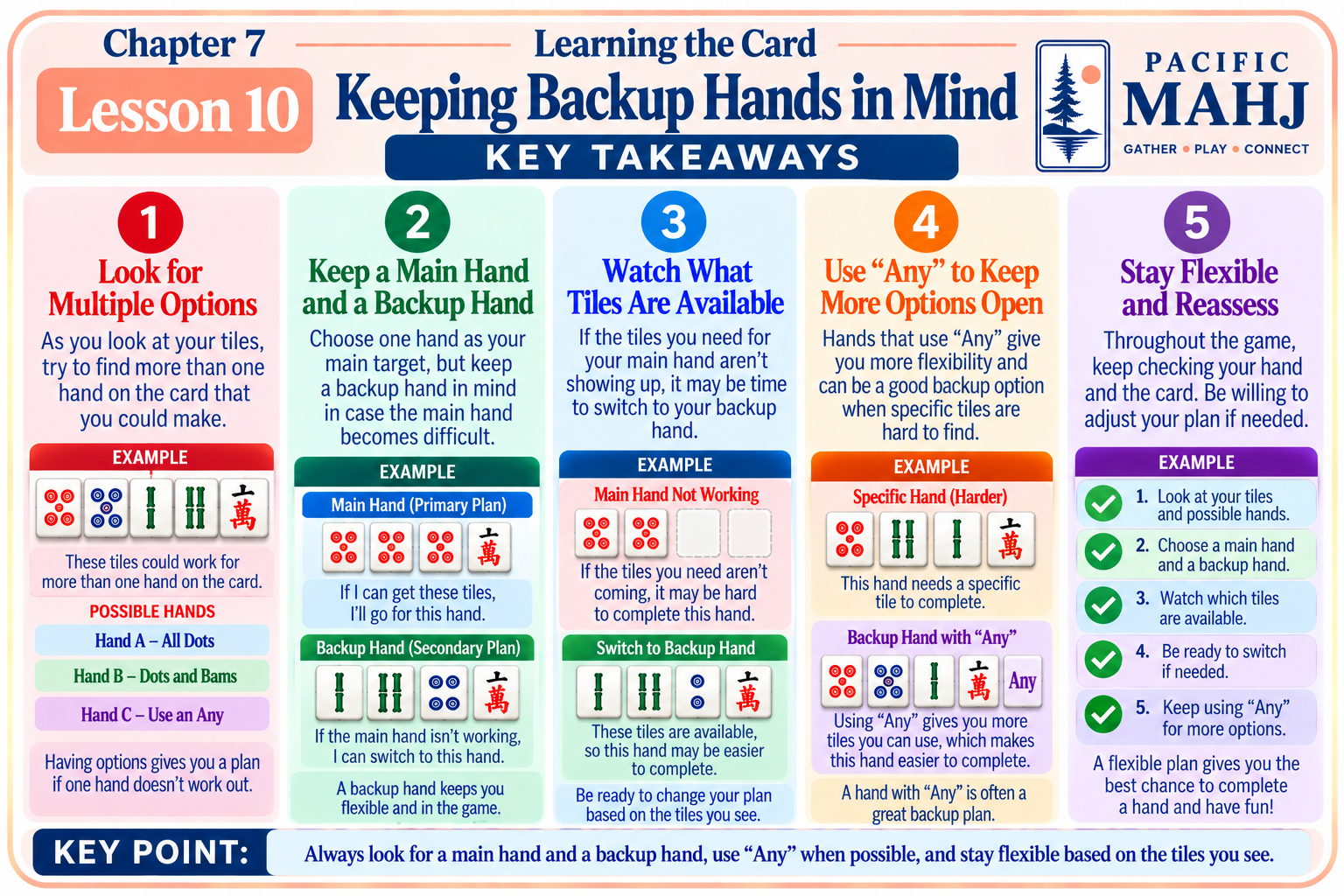
Keeping Backup Hands in Mind
A good starting hand can become difficult as tiles are discarded or other players expose what you need. Keep one or two backup possibilities in mind that share many of the same tiles. That gives you room to pivot without starting over. The best backup hand is often one that reuses the strongest groups already in your rack.
Lesson 11
Getting Comfortable with the Card
Comfort with the card comes from using it, not memorizing it. Scan the sections, compare a few promising lines, read every instruction and keep checking the card as your hand changes. Over time, common patterns will begin to stand out automatically. Give yourself permission to look, compare, reconsider and ask questions while you learn.
Chapter Complete
The Card Is Starting to Make Sense
You now know how to navigate the card instead of simply staring at a wall of colors and numbers. Keep using it while you play. Look for sections that fit your tiles, read each promising line carefully, and stay flexible when the hand changes. Next, we’ll build on these skills and focus on making stronger decisions during the game.